
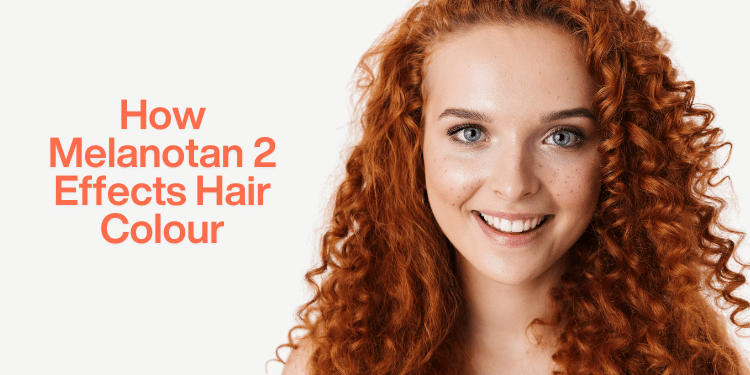
Some people using Melanotan 2 report changes in facial hair, eyebrows, eyelashes or scalp-hair colour. These accounts are discussed particularly often by people with naturally red or ginger hair. However, direct clinical research into Melanotan 2 and human hair colour is extremely limited.
This guide separates established pigmentation science from biological inference and individual user reports. It explains why a hair-colour change may be biologically plausible without presenting it as a predictable or clinically proven effect.
Can Melanotan 2 Change Hair Colour?
The most accurate answer is that a change in hair pigmentation is biologically plausible, but it has not been adequately established through controlled human research.
Melanotan 2 interacts with melanocortin receptors. The MC1 receptor has an important role in regulating pigmentation, including the production and balance of different forms of melanin.[1]
Because melanocortin signalling is involved in both skin and hair pigmentation, this provides a possible mechanism through which Melanotan 2 could influence the pigment deposited in newly developing hair.
However, a possible biological mechanism is not the same as clinical proof. The published human studies of Melanotan 2 have primarily examined skin pigmentation and other physiological effects. They do not provide reliable figures showing:
- How frequently hair-colour changes occur
- Which types of hair are most likely to change
- How large any change might be
- Whether red or ginger hair responds differently
- How long a change may remain visible
- Whether every reported change was caused by Melanotan 2
Claims that Melanotan 2 will definitely darken red, ginger, blond or grey hair therefore go beyond the available evidence.
Understanding Eumelanin and Pheomelanin
Human hair colour is influenced by the amount, type and distribution of melanin produced within individual hair follicles.
The two melanin categories most frequently discussed in relation to visible hair colour are:
- Eumelanin: generally associated with brown and black pigmentation
- Pheomelanin: generally associated with yellow and red pigmentation
Hair colour cannot be reduced to one pigment being present and the other being absent. Human hair commonly contains a mixture, and its visible appearance depends on pigment quantity, distribution, genetics, hair structure and other biological factors.[2]
Red and ginger hair is commonly associated with a pigment balance that favours pheomelanin and with variants affecting the melanocortin 1 receptor, known as MC1R. Genetics remain more complicated than a single gene or a simple eumelanin-to-pheomelanin ratio.
What Does MC1R Have to Do With Hair Colour?
MC1R is a receptor found on pigment-producing cells called melanocytes. Signalling through this receptor helps regulate melanogenesis, the biological process through which melanin is produced.
Research into pigmentation biology identifies MC1R and its melanocortin ligands as important regulators of both the intensity and type of melanin produced.[1]
Melanotan 2 is a synthetic melanocortin analogue that can activate MC1R alongside other melanocortin receptors. Its interaction with MC1R helps explain its association with increased skin pigmentation.
It is reasonable to infer that the same signalling pathway might affect pigment production inside some hair follicles. What cannot currently be concluded is that this happens consistently, produces a particular colour, or affects everyone with the same natural hair type.
What Human Melanotan 2 Research Actually Shows
An early pilot study administered Melanotan 2 to three healthy male volunteers. Increased skin pigmentation was reported in two participants.[3]
This study helps demonstrate that Melanotan 2 can influence human pigmentation, but it was extremely small. It did not establish a general safety profile, investigate long-term effects or provide reliable evidence about changes to scalp, facial or body-hair colour.
Later medical literature has focused more heavily on adverse effects and melanocytic changes involving the skin. A published review identified case reports describing changes in existing moles and the appearance of new atypical moles following the use of unregulated melanocortin analogues. The authors also noted that conclusive evidence establishing causation was lacking.[4]
This distinction matters. There is evidence that Melanotan 2 can affect pigmentation, but there is not strong clinical evidence defining how it affects human hair colour.
Why Is Red or Ginger Hair Discussed So Often?
Hair-colour changes may be easier to notice against a naturally light or red background than in hair that is already very dark.
For example, a small amount of additional dark pigment might be visually noticeable in a ginger beard, light eyebrow or pale body hair while making little obvious difference to black or dark-brown hair.
This is a reasonable explanation, but it remains an inference rather than a proven Melanotan 2 effect. There is no reliable clinical study demonstrating that people with red or ginger hair are more likely to experience a change.
Online reports describe several different experiences, including:
- Ginger facial hair appearing darker or more auburn
- Individual beard hairs becoming brown or black
- Eyebrows or eyelashes appearing more defined
- Light body hair appearing darker
- No noticeable change to hair colour
These are user-reported experiences, not controlled scientific findings. Online accounts cannot confirm the identity of the product used, exclude changes caused by lighting or UV exposure, or establish how common an effect is.
Would Existing Hair Change Colour?
A visible hair shaft is made from keratinised cells and is not biologically active in the same way as the follicle producing it.
Pigment is incorporated into a hair while it develops inside the follicle. This means a biological change in pigment production would be expected to affect newly developing hair rather than recolour the full length of a strand that has already emerged.
If a genuine pigment change occurred, it might therefore become visible gradually near the roots or as new facial and body hair grows. Differences across individual follicles could also produce an uneven or mixed appearance.
A sudden colour change affecting the complete length of existing hair would be less consistent with this mechanism and may have another explanation, including:
- Different lighting or camera settings
- Wet hair appearing darker
- Sun bleaching
- Hair products or cosmetic treatments
- Normal variation between different growth cycles
Are Possible Hair-Colour Changes Permanent?
There is not enough direct research to give a dependable reversal timeframe.
If Melanotan 2 influenced pigment production inside an active follicle, the altered colour could remain visible in the portion of hair produced during that period. A completed hair shaft cannot remove pigment through skin-cell turnover.
The visible change might remain until that section of hair is:
- Cut or shaved
- Naturally shed
- Replaced during a later hair-growth cycle
- Altered through environmental or cosmetic processes
It is possible that later hair growth could return towards its previous colour after melanocortin stimulation ends, but this has not been adequately studied in people using Melanotan 2.
The earlier claim that hair will generally return to its natural colour once melanin levels return to baseline is therefore too certain. Read our separate guide examining whether the reported effects of Melanotan 2 are reversible.
Skin Pigmentation Is Better Documented Than Hair Changes
Increased skin pigmentation is better supported than claims involving hair colour. Melanotan 2 can activate melanocortin pathways involved in cutaneous melanin production, and increased pigmentation has been observed in limited human research.
However, this should not be described as producing a safe or protective tan. The NHS states that there is no safe or healthy way to obtain a UV tan and that a tan does not protect the skin from the harmful effects of sunlight.[5]
People with pale skin, freckles or red or fair hair are specifically advised to take extra care in the sun. Appropriate shade, protective clothing and sunscreen remain important regardless of how dark the skin appears.
Melanotan 2 induced pigmentation has not been shown to make unprotected sunlight or sunbed exposure safe.
What About Freckles, Moles and Other Pigmented Areas?
Changes to freckles and moles are more important medically than a cosmetic change to hair shade.
Melanotan use has been associated in case reports with darkening or changes involving existing moles and the appearance of new melanocytic lesions. These reports do not prove that Melanotan caused every change, but they support the need for caution and professional assessment of unusual pigmentation.[4]
The NHS recommends contacting a doctor about a new growth or a mole, freckle or skin patch that changes in size, shape or colour.[5]
A pigmentation change should not automatically be dismissed as an expected response to Melanotan 2. This is particularly important if a mark:
- Changes size, shape, border or colour
- Looks different from surrounding moles
- Begins itching, bleeding or crusting
- Appears new or continues changing
More information is available in our guide to the possible effects and side effects of Melanotan 2.
What Laboratory Testing Can and Cannot Show
Laboratory analysis can provide information about the identity, measured content and reported purity of the particular sample tested.
Pure MT2 publishes its available independent laboratory analysis. The published report records a sample identified as Melanotan II, with measured content of 9.97mg and reported purity of 99%.
That report applies to the submitted sample identified by laboratory order number 100011931. It does not establish:
- That Melanotan 2 changes human hair colour
- How any individual will respond
- Clinical safety or effectiveness
- Sterility or suitability for human use
- The composition of a different sample, lot or batch
Product analysis and clinical evidence answer different questions. A purity result should not be presented as evidence for a biological effect that the laboratory did not investigate.
UK Regulatory Position
Melanotan 2 is not a licensed medicine in the United Kingdom. The UK Government has previously stated that no Melanotan product holds UK marketing authorisation and that these products are subject to medicines regulation.[6]
It has not been authorised as a treatment for changing skin pigmentation, changing hair colour or protecting the skin from ultraviolet radiation.
The absence of reliable hair-colour research is particularly important when assessing online claims. Descriptions such as “guaranteed darkening”, “permanent colour correction” or “extra UV protection for redheads” are not supported by adequate clinical evidence.
What Is the Most Accurate Conclusion?
Melanotan 2 interacts with a biological pathway involved in both skin and hair pigmentation. This makes a change in newly developing hair pigment possible in theory.
Some users, including people with naturally red or ginger hair, report darker facial hair, eyebrows, eyelashes or body hair. These accounts should be described as anecdotal because controlled human research has not established how frequently these changes occur or whether Melanotan 2 was responsible.
It is not currently possible to promise:
- That hair colour will change
- That red or ginger hair will become auburn or brown
- That the effect will be even
- That it will be temporary
- That hair will return to its previous colour within a particular timeframe
The evidence supports a cautious conclusion: hair-colour change is biologically plausible and reported by some users, but it remains poorly studied and unpredictable.
For wider background on melanocortin receptors and pigmentation, read our evidence-based guide explaining what Melanotan 2 is and how it works.
Important Information
This article is provided for general educational purposes. It does not provide medical advice or recommend the use of Melanotan products.
Anyone concerned about a new or changing mole, persistent pigmentation change or unexplained alteration in hair or skin should seek advice from a suitably qualified healthcare professional.
Sources and Further Reading
- Slominski A, et al. Melanin pigmentation in mammalian skin and its hormonal regulation. Physiological Reviews. 2004.
- Ito S, Wakamatsu K. Quantitative analysis of eumelanin and pheomelanin in humans, mice and other animals. Pigment Cell Research. 2003.
- Dorr RT, et al. Evaluation of melanotan II, a superpotent cyclic melanotropic peptide in a pilot phase I clinical study. Life Sciences. 1996.
- Habbema L, et al. Risks of unregulated use of alpha-melanocyte-stimulating hormone analogues: a review. International Journal of Dermatology. 2017.
- NHS. Sunscreen and sun safety. Reviewed 24 March 2026.
- UK Parliament. Melanotan and UK regulatory controls. Answered 16 June 2014.
Last evidence review: 18 September 2026.